In December 2020, the United Nations designated 2021 to 2030 the Decade of Healthy Aging. The declaration served as a rallying cry to elevate awareness of population aging across society, a catalyst for multi-sectoral collaboration to harness the promise of rapid demographic shifts, and an acknowledgement that population aging is a global megatrend happening in every country.
It’s important to acknowledge that the global megatrend is not happening the same in every country. The fastest demographic shifts are taking place in low-and-middle income countries (LMICs). Analysis from AARP – the world’s largest nonprofit, nonpartisan social mission organization, headquartered in the United States – indicates that LMICs will be home to nearly 80% of individuals aged 65 years and over by 2050, with the fastest growth in the 65-and-over population happening in Sub-Saharan Africa.
Nor is aging affecting every population group equally. That same analysis, from the fourth edition of AARP’s Aging Readiness and Competitiveness Initiative (ARC 4.0), found stark differences in how individuals age across the life course. Of note, while around the world, women live longer than men, they experience more years of poorer health (see Figure 1) and greater income insecurity as they age regardless of a country’s development status. »
The latest edition of the ARC (ARC 5.0) released in April 2025, explored solutions for closing the gender income security gap for older adults in LMICs. Harnessing the full economic potential of aging populations is paramount, given projections that older adults will contribute $118 trillion dollars to the global economy by midcentury. Employing meta-analysis of existing interventions and novel economic modeling, the ARC 5.0 provides insights to spur action that boosts income security for women as they age. Takeaways include:
- Annual GDP growth is strongly associated with improvements in healthy longevity for both older men and women, according to data from 172 countries;
- Social pensions positively impact recipient outcomes, including reducing poverty and increasing food security, healthcare utilization, and social participation. Mexico’s noncontributory Women’s Welfare Pension (Pensión Mujeres Bienestar) program enhances income security for women aged 60-64;
- Social pension programs bolster overall economic growth: South Africa’s Old-Age Grant model reaches nearly 75% of South Africans aged 60+ and yields 1.4 rand back to the economy for every rand invested;
- Only 55% of individuals from G7 countries and 28% from emerging economies have financial literacy to plan for their future, a barrier to income security that is strongly linked to healthy aging. Financial education programs are being deployed in response, such as Singapore’s Citi-Tsao Financial Education Programme for Mature Women, which has been effective in supporting long-term financial self-sufficiency.
As we enter the second half of the Decade of Healthy Aging, the global community must turn to each other for solutions to achieve the Decade’s promise: a world fit for individuals as they age. Insights from AARP underscore the need for this approach, showcasing solutions from around the world to boost income security and wellbeing of older women: comprising a majority of the world’s older adult population in the decades to come. Leaders and practitioners must leverage shared knowledge and experiences to embrace global solutions to ensure a world where older adults can thrive and function.
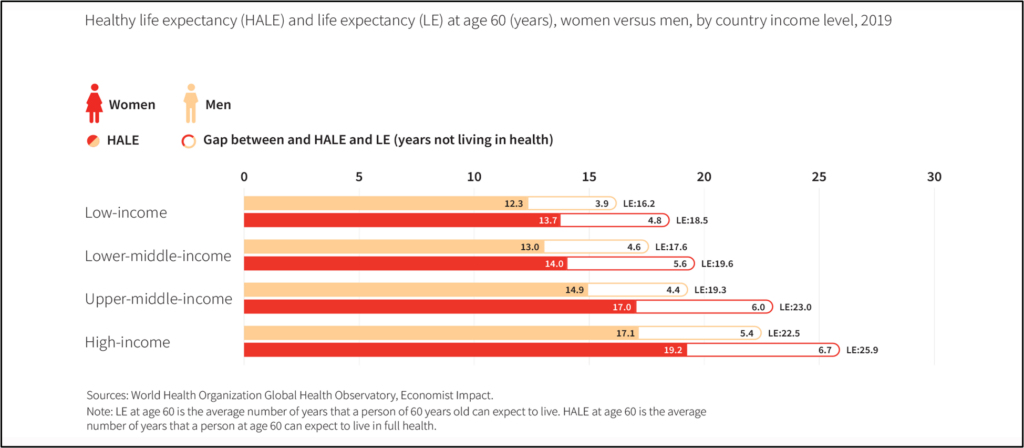
Figure 1. Across countries of different income levels, women live longer than men but in more years of poor health in later life (Figure and caption adopted from the ARC 4.0 report and modified with permission from AARP).
Founded in 1958, AARP is the world’s largest nonprofit, nonpartisan social mission organization dedicated to the 50-and-over population. With headquarters in Washington (United States) and a network of 53 offices in each state, the U.S. Virgin Islands, Puerto Rico, and the District of Columbia, AARP’s mission is to empower people to choose how they live as they age and envision a society in which all people live with dignity and purpose, and fulfill their goals and dreams.
- Joy Barresi Saucier, MHA, RN, FACHE, is a 2025-2026 Health and Aging Policy Fellow placed with AARP International to explore global best practices that enhance the economic security of older women living in rural communities. She serves as Executive Director of the Aroostook Agency on Aging in rural, northern Maine, USA, where she is focused on supporting older people to thrive in their home communities. Ms. Barresi Saucier is board certified in healthcare management and is a Fellow of the American College of Healthcare Executives. She is past chair of the Maine Development Foundation and the Maine Association of Agencies on Aging, and currently serves on boards of numerous local, state, and national organizations including USAging. Beginning her career as a Registered Nurse graduating from the University of Maine School of Nursing, she later received a Master of Health Administration degree from St. Joseph’s College of Maine. For over 25 years prior to joining the Agency, Ms. Barresi Saucier worked in a variety of healthcare positions including patient care, community health, philanthropy, and executive leadership. A Rotary Paul Harris Fellow, she is past president of the Rotary Club of Presque Isle, Maine, USA, and serves as Foundation Chair of Rotary District 7790. In all roles, she remains dedicated to ensuring all individuals can age well in the community of their choice.
- A cognitive neuroscientist by training, Dr. Vijeth Iyengar is the Director of Global Aging at AARP where he leads innovative research, drives thought leadership on global aging issues and cultivates strategic alliances to promote the enterprises vision for the global 50+ population.Previously, Dr. Iyengar spent half-a-decade as a civil servant in the U.S. Government advancing a range of policies and programs to improve the overall health and well-being of older Americans and their families. During this period – spanning the Obama, Trump, and Biden administrations – he served as Policy Advisor to the Chief Technology Officer at the White House Office of Science and Technology Policy and as Brain Health Lead and Technical Advisor to the Deputy Assistant Secretary for Aging. Dr. Iyengar’s writings and insights have appeared in numerous domestic and international outlets, notably the Bangkok Post, Brookings, Council on Foreign Relations, Devex, Forbes, and the Hindustan Times. Among other honors, he is an elected Member of the National Academy of Social Insurance, selected as an Aspen Ideas Health Fellow, a Presidential Management Fellow, and a National Science Foundation Graduate Research Fellow. Currently, Dr. Iyengar serves as an Atlantic Council Nonresident Senior Fellow, a Salzburg Global Fellow, Advisor to Ashoka, and Advisor to Indian-based NGO, Vayah Vikas. Born and raised in South Louisiana, he was a visiting undergraduate student at Cornell University, earned a bachelor’s degree from Tulane University, and master’s and doctoral degrees from Duke University.